Showing posts with label louie simmons. Show all posts

Thursday, December 1, 2016

The Best Training Program Is No Training Program.

One of the most talked about topics I see in the fitness blog-o-sphere and social media is programming. I always see comments asking “what program you’re doing”, or “I’m starting this program Monday”. I used to read a popular online muscle zine’ and every time an author would post a training article the comments would read “Starting this tomorrow!”, “just what I needed!” and so on.

I’m here to tell you that the absolute best program you can do is no program. Unfortunately this truth won’t sit well with fitness journalists and gurus who need to publish the latest, greatest training program each month. Plus endless articles about training principles would be incredibly boring for the average gym rat. However, that is where the results are at, in the principles.
EPTS athlete and BJJ brown belt Chris Jones uses exercises HE needs for his sport.
It’s about principles not programs.

The problem with programs is that one size does not fit all. Programs don’t take into account an individual’s weak points. No one should train exactly the same. That doesn’t mean a group of powerlifters shouldn’t squat or bench press, but how they go about building those movements may differ greatly. If someone’s hamstrings are a weak point in the deadlift, they will prioritize different accessory exercises than someone who’s lower back is a weak point.

Before I continue I do believe programs are good for beginners. If you are just starting out and have less than 1-2 years of consistent training under your belt, a well balanced program is a good idea. Something that trains all muscle groups in a balanced manner with a wide variety of exercises. This isn’t time for the super secret Russian squat, bench, deadlift only for hard comrades training program. If you are a beginner you need to build muscle and strength. A program introducing compound exercises with appropriately selected single joint exercises that increases in volume and intensity over time will deliver great results. Eventually some movements and muscle groups will start to slow in progress and it’s at this point you will need to learn to take responsibility for your training and learn the principles of training.

Using accomodating resistance for speed deadlifts to build rate of force production and lockout strength.
The principles.

According to Vladimir Zatsiorsky, in his book “Science and Practice of Strength Training”, there are three methods of training to increase muscular tension.

  1. Maximal Effort Method - lifting a maximal weight.
  2. Dynamic Effort Method - lifting a non-maximal load with the greatest possible force.
  3. Repeated Effort Method - lifting a non-maximal load to failure.
*There is also a method he refers to as the sub-maximal effort method, which is the lifting of a non-maximal load for an intermediate number of repetitions without going to failure.

These training methods also make up a significant part of the work my mentor Louie Simmons has successfully done with athletes as well as his world famous powerlifting team. Louie takes these methods, and scientifically backed training principles, and applies them to powerlifting, as well as other sports like fighting, track, football and many others. On a recent visit to Westside Barbell I was having breakfast with Louie and his crew and he confirmed a suspicion I had as to why most people don’t understand his conjugate training method. People are always looking for a program, a cookie cutter template they can take to the gym and do without any thought. That’s not what his method teaches. His method teaches you the scientific principles of training but you need to learn how to apply them to your sport. He said to me that it is important to learn how to train yourself by constantly assessing your progress and implementing the appropriate exercises to build your weak points and that no two athletes or lifters programs are identical.
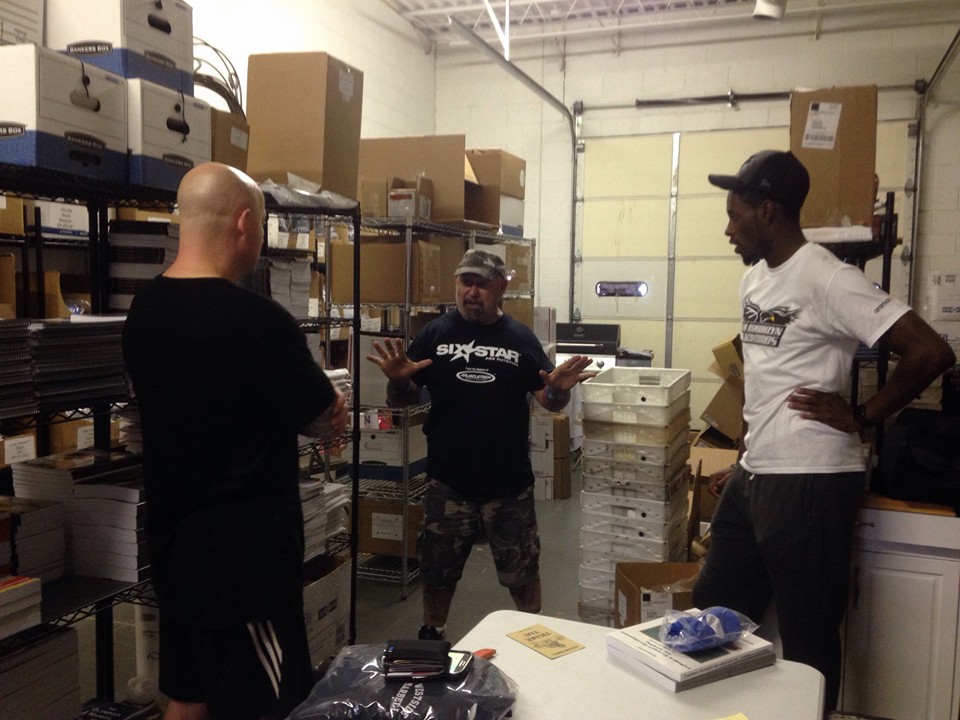
Learning from Louie himself. If you want to understand the Westside method, you have to go to Westside.
In order to get stronger you must raise your training volume and intensity over time. In short you need to lift heavier weights and do more work while addressing all training principles and variables appropriately. Sure, some people like to say getting strong isn’t rocket science, you just add more weight to the bar, but I have yet to see a high level athlete who doesn’t pay attention to every detail of his physical training program.

Does this apply to the strength enthusiast? Absolutely. Whether you are training to be a world champion or just to get stronger and more generally fit you need to apply the appropriate principles to your training.
Just some of the equipment our athletes and clients have access to at Extreme Performance Training Systems.
Don’t fall into the trap of doing the latest program your favorite muscle rag or blogger has posted, take the time to evaluate your training and learn how to build and evolve a training plan that will allow you to accomplish your personal goals.

Stay Strong and Healthy!

-Scott

Tuesday, May 10, 2016

Optimal Training Methods for Enhanced Swimming Performance.

One of the biggest problems with dryland strength training for swimming is exercise selection. This is where the idea of “sport specific” training drives me a little nuts. True specificity is the practice of the sport itself. While lifting weights is sport specific to powerlifting and weightlifting, lifting weights is general preparation for other sports. That being said it is important to select the appropriate exercises and loading parameters to complement the specific sport training.

Karl Krug, 2015 50m freestyle Canadian Champion.
One of our top athletes at Team EPTS is a freestyle sprint swimmer, Karl. Karl is one of the top swimmers for Canada where he won the national title in the 50 meter freestyle event in 2015. Karl has had a great career coming out of high school as one of the top swimmers in California and going on to Auburn University where he was a 9 time all American.


At his level specificity rules and all the training we do needs to have one focus, to make him the best swimmer possible. Unfortunately athletic preparation sucks in the US. Here we tend to specialize our kids way too early. When kids are young they should be exposed to a wide range of exercises and activities in order to build a broad base of general physical preparedness. That way when the young athlete is reaching middle-school age their dominant abilities should be apparent and the athlete will be ready to specialize in a sport that matches their those abilities.


Karl using compound resistance (weights & bands) on Louie Simmon's Virtual Force Swing at Westside Barbell.
At Extreme Performance Training Systems we don’t cycle or do training blocks. Instead we focus on the development of maximal strength, speed, power, hypertrophy, conditioning, etc. on a weekly basis. Our training is heavily influenced by the work of Louie Simmons of the Westside Barbell Club. Like Louie says, “there are only two ways to train, the right way and the wrong way.” One method we’ve found to be extremely beneficial for Karl’s swimming preparation is accommodating resistance, where we attach high tension bands and heavy chains to free weights during the performance of general strength exercises.

While we usually use accommodating resistance during speed-strength and strength-speed exercises, we have found them to be beneficial during the maximal effort and repeated effort special strengths exercises as well.


This is exceptionally effective for swimmers due to the hydrodynamic resistance they encounter in the pool. Hydrodynamic resistance is extremely difficult to replicate during dryland training without special machines where the resistance is provided by viscosity. In this case the exerted muscular force is proportional to the movement velocity. According to Vladimir Zatsiorsky in his book, “Science and Practice of Strength Training”, compound (or accommodating) resistance is an excellent alternative for the dryland training of swimmers.


Zatsiorsky describes compound resistance as attaching a rubber band to the floor or a fixed object and a barbell. When the barbell is lifted the athlete overcomes the barbell weight, which is constant, the barbell inertia which is proportional to the acceleration of the barbell, and the elastic force which grows larger the higher the barbell is lifted. (Zatsiorsky pp. 25-26)

Using bands and chains to accommodate resistance.
We have seen great benefits using bands for exercises that work the primary muscle groups used in Karl’s event. Movements for the legs and hips, torso, lats, and triceps in particular. We attach the bands to the barbells, lat pulley machine, dumbbells or the body during various squats, good mornings, deadlifts, pull-ups, lat pulls, triceps extensions, and pullovers among many other movements.


Remember, in order to be optimal, the training of an athlete must be highly specialized as no two athletes have the exact same strengths, weaknesses, leverages, etc. Training cannot be cookie cutter and needs to be implemented with the individual in mind and specificity rules.


Stay Strong AND Healthy!


-Scott

Karl with Louie at Westside Barbell.
Scott with Louie at Westside Barbell.

Kraemer, W., Zatsiorsky, V. (2006). Science and Practice of Strength Training (2nd ed.). Champaign, IL: Human Kinetics.

Thursday, April 21, 2016

Strength & Health TV - Episode 31: Reverse Hyper - the Best Exercise for Lower Back Strength.

In this week's episode I talk about what I consider to be the best exercise for lower back strength and health, the reverse hyper extension.

The reverse hyper extension bench was created by Louie Simmons. Louie has numerous reverse hyper benches with patents on each.

In this video I go over how to correctly perform the exercise and how to determine the optimal loading parameters to fit this exercise in your training program. The information I provide is what I've learned from Louie's work and how we've successfully implemented this in our programming at EPTS. I have talked to, and heard from, numerous people who write off this exercise as a waste of time and when I look at how they utilize it - typically a couple of sets with light weight at the end of a session - it's no wonder. To get the most out of this exercise you have to use the proper load and volume.

In addition to this video I strongly encourage you to read Louie's articles, books, and watch his videos and DVDs. The amount of information he provides on strength training is worth its weight in gold and you are doing yourself, and your athletes and clients, a disservice by not studying his work.

You can learn more about the reverse hyper and Louie's work by visiting his website at: https://westside-barbell.com/


Stay Strong AND Healthy,

-Scott

Saturday, April 2, 2016

Strength & Health TV - Episode 29: The Correct Way to Set Up and Use Bands and Chains.

In this video I talk about the proper way to set up and use bands and chains in strength training as tools for accommodating resistance.

Despite popular opinion from internet "gurus" bands and chains (as well as all other aspects of the Westside Barbell Method) are a very effective form of accommodating resistance that will help you take your training to another level. This stuff is not just for equipped powerlifters, it is for anyone who is interested in developing high levels of strength, power, speed, and overall athletic performance.

In the video I discuss the correct way to set up bands and chains for the squat and bench press, why you should ignore the studies presented in the NSCA Journal of Strength and Conditioning, the benefits of using accommodating resistance in your training plan, and much more.

For more in-depth information please go to the man himself, Louie Simmons of Westside Barbell. Louie is the reason we know anything about the use of bands and chains in strength training and has written and spoken extensively about the proper way to implement accommodating resistance in strength training, powerlifting, and athletic preparation and the benefits in doing.

For information from Louie, click here. 

Hopefully you enjoyed this week's episode and if you have any questions or suggestions on future topics please leave them in the comments below.


Click here to subscribe to my YouTube channel to receive updates on future shows.

Stay Strong AND Healthy!

-Scott

Follow me online:
http://www.scottshetler.com
http://www.extreme-fitness.org
http://www.facebook.com/sshetlerfitness
http://www.twitter.com/sshetler

Friday, October 16, 2015

Strength and Health TV - Episode 13: My Journey to Westside Barbell & Bonus Episode 13.5.

In this week's episode I recap some of the information I learned from Louie Simmons when one of my athletes and I visited him at his Westside Barbell Club in Columbus, OH a couple of weeks ago.

I've been a fan of Louie's work for over 10 years now and have benefitted tremendously from the information he's shared through is videos, books, and website. I've used his methods extensively, and with great success, with many of the athletes, lifters and clients I've trained over the years and getting to work with him in person was amazing.

Not only did he work with us on my athlete's strength and conditioning preparation for his 2016 Olympic Trials but I got to work with him on my own training as well.

Louie has more knowledge combined with practical experience than anyone I've ever met and it was an absolute honor to train with him. He and everyone else at Westside were very gracious with their time and very informative. I can't wait to go back!

I hope you enjoyed this week's episode and be sure to check out Episode 13.5 - a bonus video I put together of the chair deadlift Louie taught me to help with building my deadlift technique and strength.


In this week's bonus video I am demonstrating an exercise Louie Simmons taught me to help improve my technique and build strength in the deadlift. This is an exercise he developed to help strengthen and utilize the hips and he suggested that after watching me work up in the deadlift and saw that as the weights got heavier I started using my legs and back and wasn't pulling back into the deadlift enough to engage my hips.

This exercise is brilliant and has already helped me improve my technique dramatically.

I hope you enjoy the video and be sure to give this a shot to see if it will benefit your deadlift as well.

Stay Strong AND Healthy!

Scott